

<3
Happy holidays! Enjoy our writing, then log out of your inbox and spend some time with family. Thank you for a great year!
WRITE FOR KOMUNE LONG-FORM
It’s almost the new year and one of our 2025 resolutions is building out Komune Long-Form. We have been reaching out to writers, asking for guest contributions. If you are interested in contributing, or know anyone that would be, please send alex@komune.space an email.
_,.-'~'-.,__,.-'~'-.,__,.-'~'-.,__,.-'~'-.,__,.-'~'-.,__,.-'~'-.,_
MEDIA HIGHLIGHT
>>> Group Show Explainer
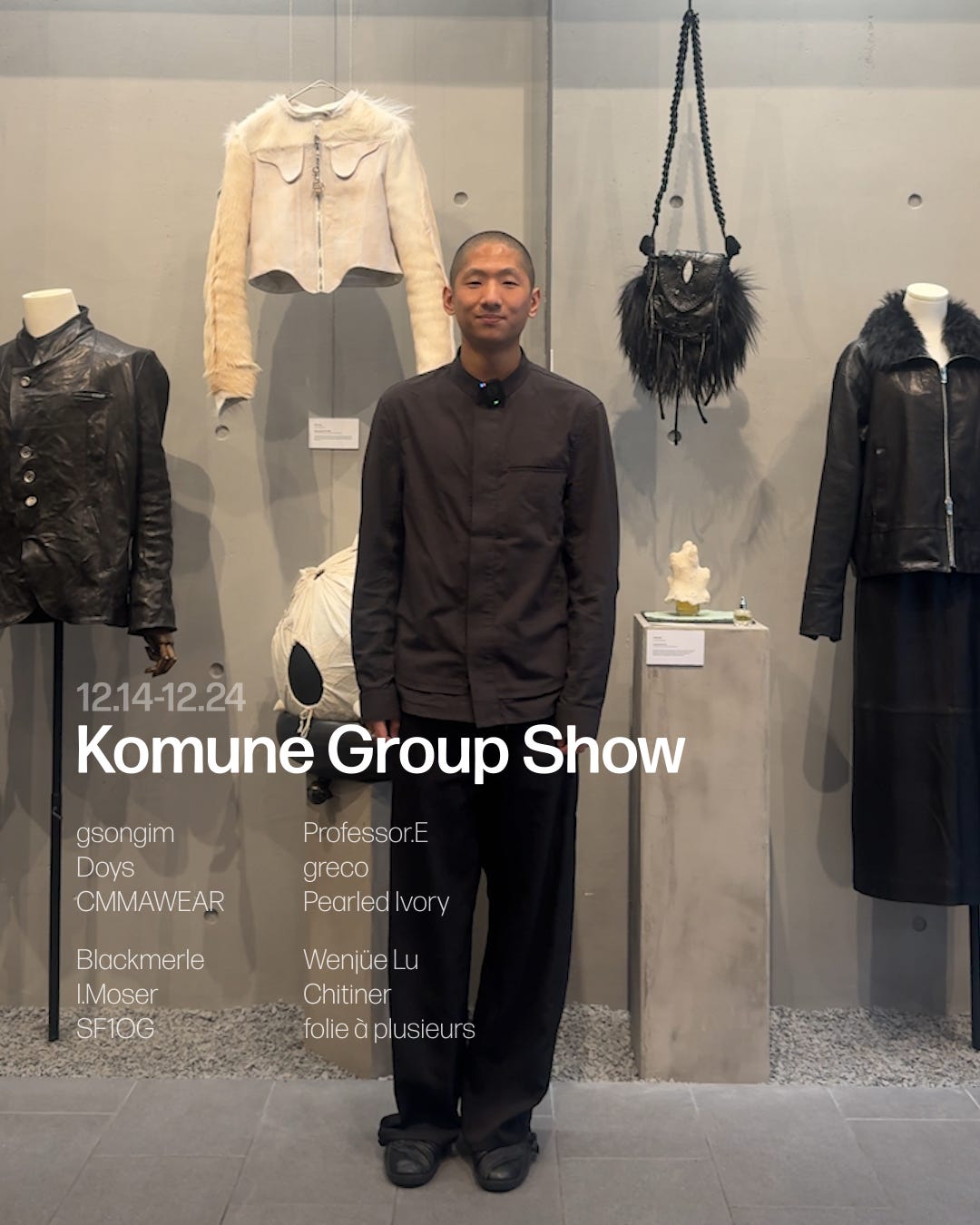
Check out this explainer video we posted, about each designer we included in our Group Show.
Each piece is available online and in-person until Tuesday, 12/24. Additionally, we have a YouTube video in the works to document the project as a whole… stay tuned!
_,.-'~'-.,__,.-'~'-.,__,.-'~'-.,__,.-'~'-.,__,.-'~'-.,__,.-'~'-.,_
ALEX
>>> I Hate TLDRs
Before bed last night, I decided to watch some videos about Art Basel. I found myself in a rabbit hole of gallery tours. I wasn’t focused on the narrators showcasing the exhibits, rather, I was fixated on the gallery visitors in the background. Over and over again, a visitor would glance at a piece, furrow their brow—if they were especially valiant, they would pace and stare from a different angle—but ultimately they would concede defeat and turn their attention to the paragraphs of description accompanying the work. Some folks completely ignore the work, beelining to the plaque next to it. The art practically functioned as an infographic for the accompanying plaque.
In the dark, I sat their writhing in discomfort (not exaggeration). It reminded me of the suffocating obsession with "a work’s meaning" or “the point”, which I have been noticing around me recently.
Form and concept are two opposed components of art. Form refers to the material, visual, and sensory aspects of a work—its composition, medium, color, texture, and physical presence. It is the ”how” of the artwork, the mode through which the viewer encounters and experiences it on a visceral level. Concept, on the other hand, refers to the symbolic content of a piece—the “why”. It is the underlying idea, message, or narrative that drives the creation and interpretation of the work.
For most of art history, form took precedence, serving as the primary vehicle for artistic expression. Think French Academic paintings or Neoclassical styles.
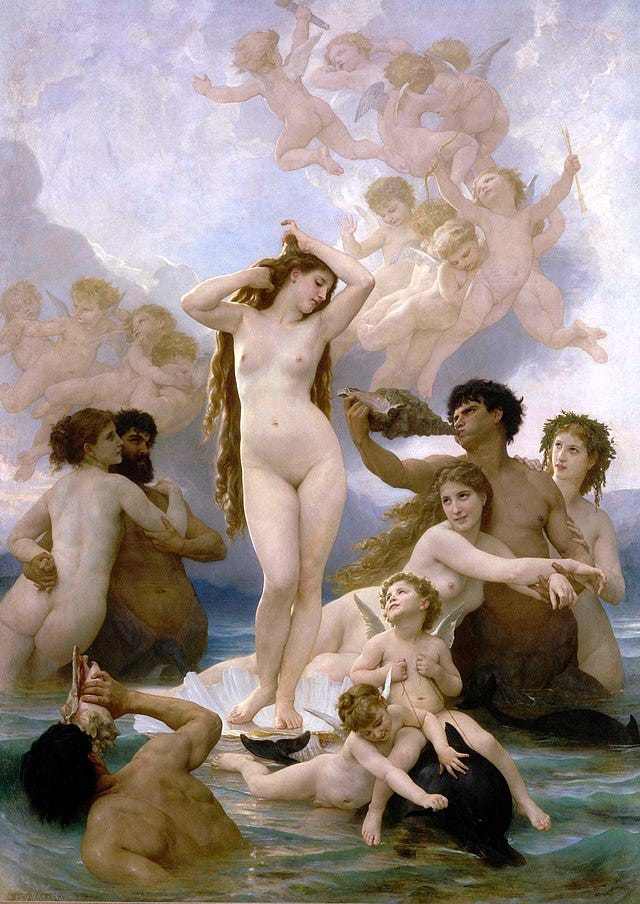
However, since the 1960s, there has been a gradual hegemony of conceptual art. Sure, this was initially avant-garde in its challenge to traditional aesthetics—revolutionary simply by virtue of what it was. However, this elevation of concept over form has, over the decades, grown into a formulaic and redundant mode of art-making. Modern conceptual art chameleons as revolutionary, but lacks any vitality or innovation, as I will explain.
If anything, conceptual art is safe. Conceptual art has a single operative component: the idea. Therefore, the only way to judge the work is on the merit of the message. Thus, the work becomes not a site of feeling but of comprehension, where the viewer's response is reduced to a binary agreement or disagreement with the artist’s ideological agenda. This is art as argument, not art as experience.
Ok, I am going to rant a bit…
Conceptual art leaves no opportunity for any subjective response. You can't have a visceral attraction or repulsion to the work. What happened to just standing in front of a painting and having an aesthetic experience? Why is everything so objective-oriented? Gallery viewers walk into an exhibit and immediately fixate on being able to walk out with an “understanding” of the exhibit, neglecting the actual process of viewing the exhibit itself.
Hegel reminds us, aesthetics is the science of feeling. Art is supposed to engender feeling. Feeling is fundamentally inarticulable! Verbalizing feeling is so reductive, yet we obsessive over deriving “the point” or identifying the concept. Folks are so afraid of misinterpreting the concept of an art, that they ignore form and immediately concede to the purported reality of a work’s explanation. Why can't we just stand there in silence and think about how the work makes us feel? Feeling defies language. It defies discourse. It's purely subjective, yet we try to make it objective by explaining it in a sterile act of intellectual assent or dissent.
And this isn’t just me and the voices; I see detriments IRL.
This dominance of conceptual art has fostered a curatorial laziness, where works are evaluated not for their aesthetic quality but for their ideological alignment. I have observed an increased number of “concept galleries”—those that exhibit art that signals conformity to socially sanctioned narratives. These galleries are dotted with works that are morally charged but aesthetically barren, posturing as radical yet wholly unthreatening to the power structures they ostensibly critique. It’s all signaling! These galleries are propped up by deep pockets and if the works posed a legitimate threat to the depth of these pockets, they would never see the light of day.
The obsession with concept trickles down to writing too. Writing has been perverted into a purely functional tool. What happened to artistic writing, to reveling in the process of reading, rather than the product? Reading is supposed to have a bit of resistance. When did writing become strictly about communication? Why not take a second to expend some brain power on deciphering what is being said. Is the best part of a book when we are done with it? I've heard that the vocabulary I use isn't colloquial enough, which implies that I write for a lay reader's understanding. I am not! I write for the sake of writing! Why can't I be intrinsically motivated, rather than pine for broad attention? I chose these words because their alternatives misconstrue what I am trying to say. I don’t care to maximize the number of readers that understand my “gist”.
As Roland Barthes might argue, the pleasure of reading, lies in the jouissance of the process. To reduce it to mere purpose is to deny the fundamental vitality of the experience itself. Writing has capacity to move, like art. The most profound experiences of such are those that resist reduction to language or discourse. Feeling—raw, unmediated, and inarticulable! It is this immediacy, this refusal to collapse into the tyranny of explanation, that is truly the power of writing. Maybe this isn’t a universal experience and its uniquely American—a product of capitalist motivations to “be more productive” or “to optimize”.
Regardless, the gallery tours made me sad. Let’s all listen to Richard Serra: "What you see is what you see." I implore you: look at the work, read the words. Enjoy the act of looking. Enjoy the act of reading.
---
LIA
>>> 價值連城,完璧歸趙
i recently hung out with my sister and asked her the classic question: "if you could go back in time to witness 1 event, what would it be?"
typically, when i ask my peers this question, many say any of (1) the trojan horse (2) roaring 20s, or (3) the fall of the berlin wall
but my sister had a completely different answer. she said she recently learned of a story/myth that led to the idioms: 價值連城,完璧歸趙
the story goes: During the warring states, King Huiwen of Zhao acquired the He Shi Jade, a highly valued artifact from the state of Chu. When King Zhaoxiang of Qin heard about this, he sent a letter to the King of Zhao, offering to exchange fifteen cities for the jade.
King Zhao discussed the matter with his generals and ministers, including the great general Lian Po. They faced a dilemma: if they agreed to the exchange, they feared Qin would not actually deliver the cities and Zhao would be deceived; if they refused, they worried Qin might retaliate with military force. Unable to decide, they searched for someone suitable to respond to Qin's proposal, but no one seemed qualified.
Finally, an eunuch named Miu Xian suggested, "My retainer, Lin Xiangru, is capable of handling this mission." With that, King Zhao sent Lin Xiangru to deliver the jade to Qin.
When Lin Xiangru arrived, King Zhaoxiang received him at the Zhangtai Palace. Lin presented the jade to the Qin king, who was overjoyed. The king passed it around for his concubines and attendants to admire, and everyone cheered in celebration.
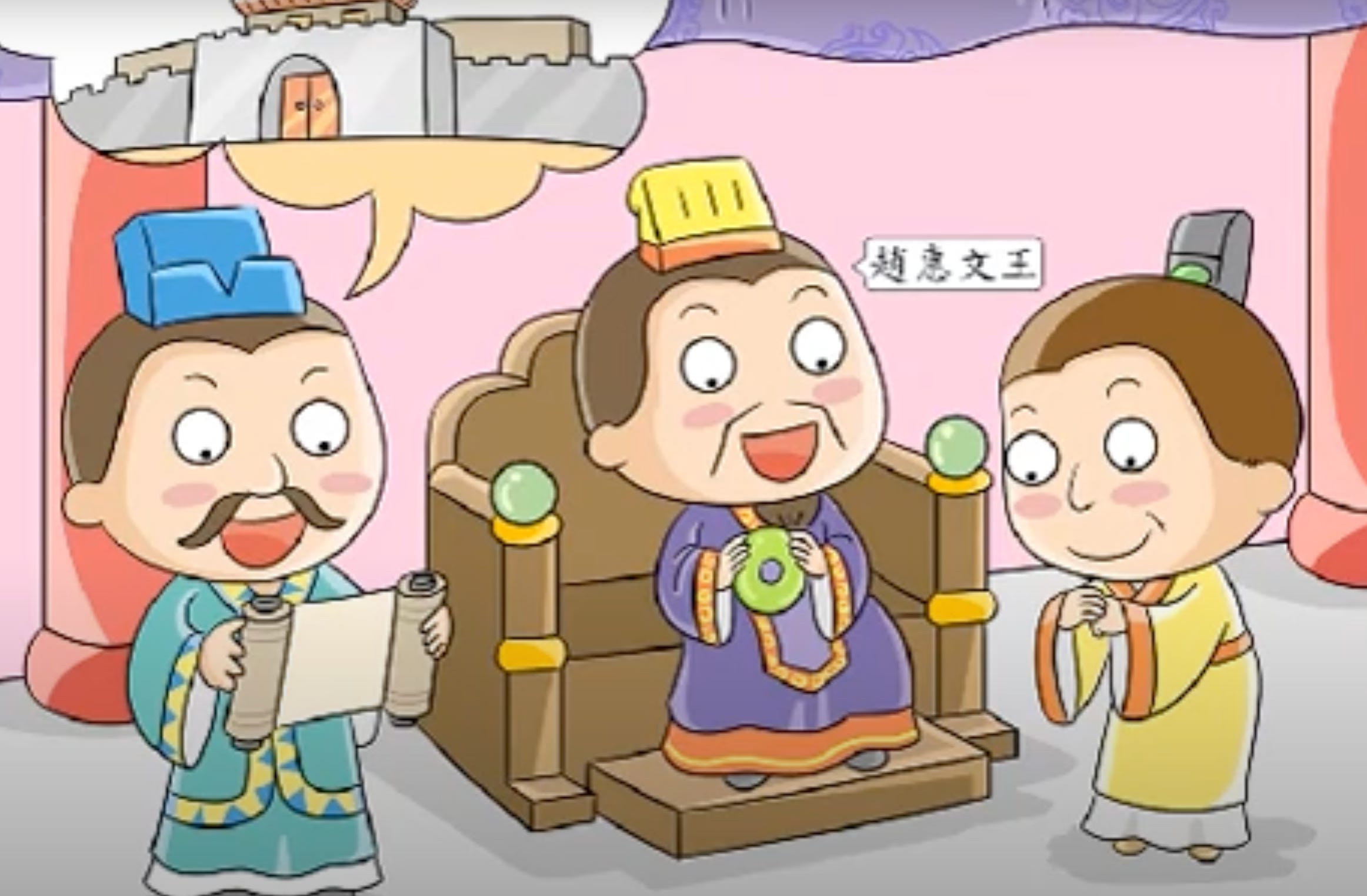
However, Lin Xiangru noticed that the Qin king had no intention of fulfilling his promise to cede the cities. He approached the king and said, “This jade has a flaw. May I point it out to Your Majesty?”
Holding the jade, Lin Xiangru moved closer to a pillar as if to show the flaw, but he intended to smash the jade against himself into the pillar. Alarmed, King Zhaoxiang pleaded with him to stop and assured him of his sincerity. The king even summoned officials to draw up a map indicating the fifteen cities he would grant to Zhao.
Lin Xiangru, however, judged that the Qin king was merely pretending and had no intention of honoring his promise. He told the king, “The He Shi Jade is a treasure of immense value, celebrated throughout the world. My king was reluctant to part with it but dared not refuse your request. Before sending the jade, my king observed five days of purification rituals. Now, I ask Your Majesty to also perform purification rituals for five days and arrange a formal ceremony at the court. Only then will I dare to present the jade again.”
The Qin king, realizing he could not forcefully take the jade, reluctantly agreed to the purification rituals (fasting) and allowed Lin Xiangru to stay in a guesthouse for five days. During this time, Lin secretly instructed his servant, disguised in plain clothes, to smuggle the jade back to Zhao through a secret route.
After realizing the jade was gone, some of the Qin courtiers wanted to arrest Lin Xiangru. Xiangru told the enraged king that he would willingly accept the Qin death penalty for deceiving a king, and requested the pēng (烹, "death by boiling") punishment. However, King Zhaoxiang stopped them, saying, “If we kill him now, we still won’t get the jade, and it will completely ruin relations between Qin and Zhao. It’s better to treat him well and send him back to Zhao. Would King Zhao really deceive Qin over just one piece of jade?”
Ultimately, the Qin king hosted Lin Xiangru in court with full formalities and allowed him to return to Zhao unharmed. Upon his return, Lin Xiangru was praised by King Zhao for his cleverness and success in preserving Zhao’s honor. He was promoted to Senior Minister.
As for Qin, it never delivered the promised cities, and Zhao, in turn, kept the He Shi Jade.
tl;dr: Zhao had an important jade artifact (HeShiBi). Qin wanted it. Qin offers 15 cities for the artifact. Zhao is sussed out and asks a trustworthy general (Lin) to deliver the HeShiBi. Lin goes, and is still sussed out. Lin tells Qin that he needs to fast for 5 days to receive the HeShiBi. Lin secretly sends the HeShiBi back to Zhao. Qin does not have the HeShiBi. Lin is celebrated for being clever.
i thought really hard about the moral of the story. is it that the Zhao has the "mandate of heaven" and so the "gods" allowed for the rightful return of the HeShiBi? is it that Lin Xiangru was so selfless / patriotic that he would rather die than let someone deceive his leader? or is it propaganda that the Qin were so dumb they would fast for 5 days and let Lin get away with sending the HeShiBi back?
maybe the lack of "western morals" is why these stories don't stick as much in my mind as others do. many stories that are glamorized in western culture, or at least american culture, is the idea of freedom: (1) the trojan horse was a cunning strategy to free Helen, wife of King Menelaus of Sparta, (2) roaring 20s were a time where the roles of women changed significantly, (3) fall of the berlin wall represents the end of a totalitarian system. the idea of freedom is not apparent in the story of this HeShiBi, but rather values of patriotism, sacrifice, and honor.
or maybe i'm just making excuses for not learning enough of ancient chinese history.
---
ALEX
>>> Grading with Shapely Values
I recently completed CMSC 20310 Designing Interaction—a class focused on designing user interfaces with a user experience-centric perspective. Professor Doe (I redacted my lovely professor’s name to preserve their privacy) frequently assigned group projects. However, group projects introduce ambiguity: how do we evaluate individual contributions fairly? Is coding the front end interface the same value-add, as coding the back end logic? How about designing the physical machine prototype? Perhaps we can use Shapely Values to equitably distribute grades
What is a Shapely Value?
The Shapley value is a solution concept named after Lloyd Shapley, who introduced it in 1951. It is used in game theory to fairly distribute both gains and costs to several actors working in a coalition.
To illustrate how this would be applied to a group project, let’s create an imaginary scenario.
Alex, Cassie, and Lia are in an art class together. They are assigned an extra credit project, to create an art exhibition (based on a true story). Everyone makes a distinct contribution:
Alex finds the artists
Cassie finds the gallery
Lia designs the space.
The teacher is moderately pleased with the result and gives them 10 bonus points, to be distributed among themselves. Lia simulates outcomes based on different team compositions:
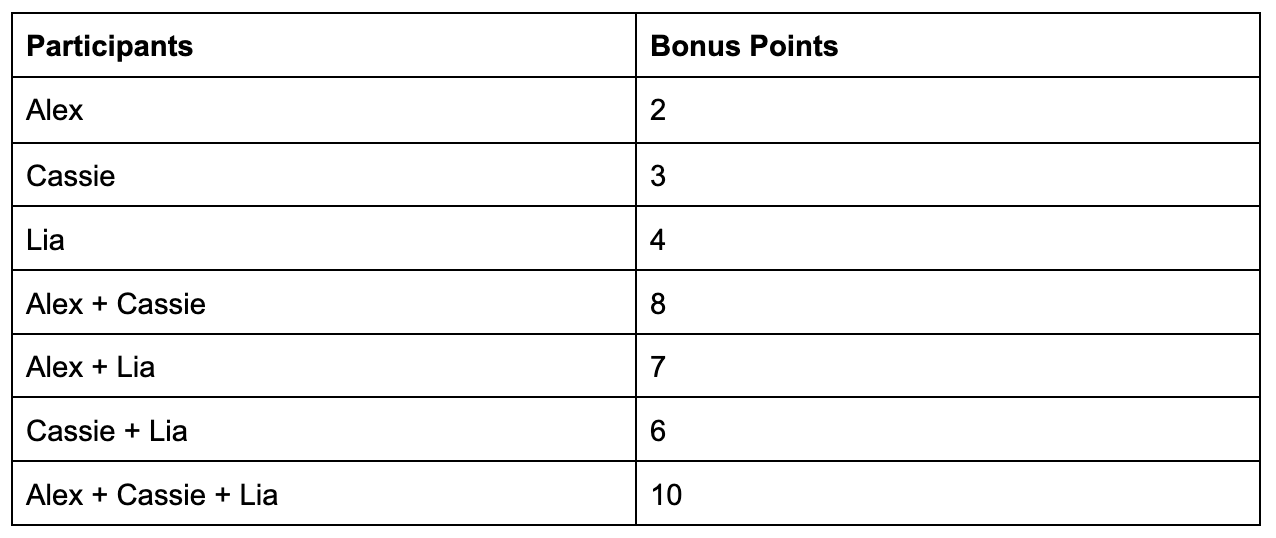
We can see that individually, each team member generates a different number of points, but when they combine their efforts, we see the total pay off increase. In fact, it increases more than the simple sum of their efforts. Where does this surplus come from? In game theory, this bonus is called the “synergy”. For instance, Alex and Cassie together earn 8 points, which exceeds the sum of their individual contributions (2 + 3 = 5). This surplus of 3 points reflects their synergistic value.
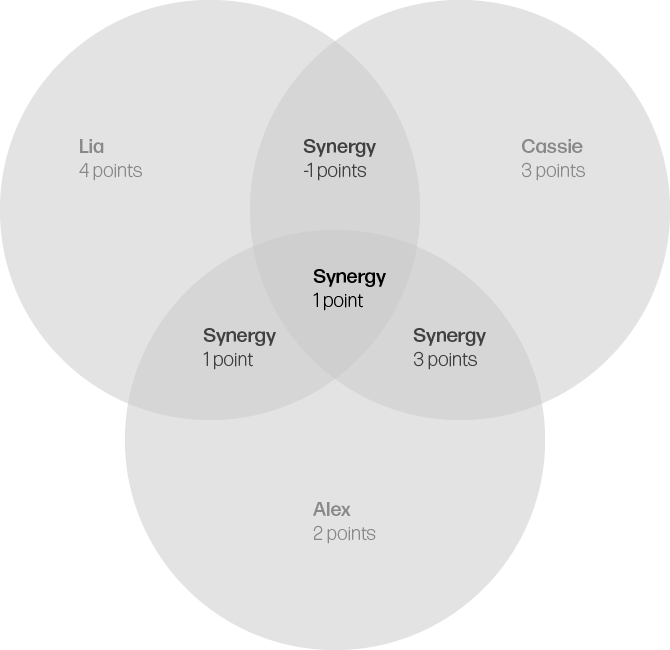
To calculate the synergies, we
Determine the marginal contribution from working in a given coalition.
Average these contributions over all coalitions.
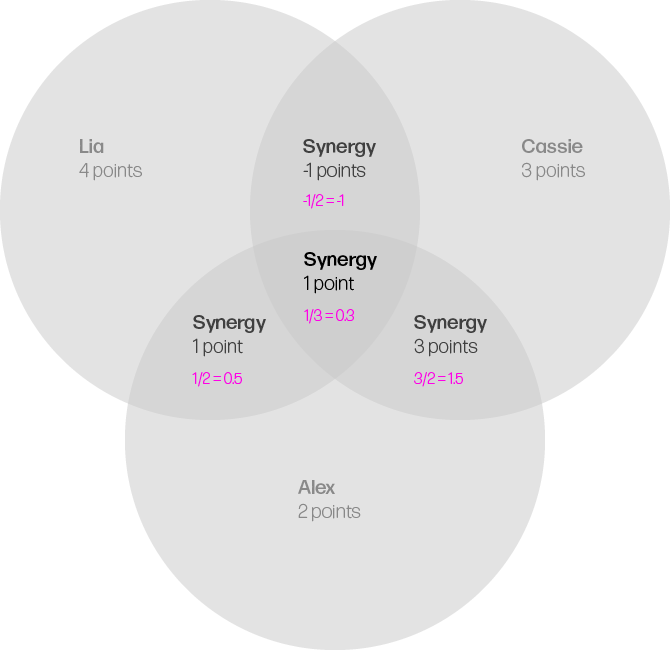
Here’s how the final allocation looks:
Alex: 2 + (synergy contributions) = 2.3
Cassie: 3 + (synergy contributions) = 3.8
Lia: 4 + (synergy contributions) = 3.8
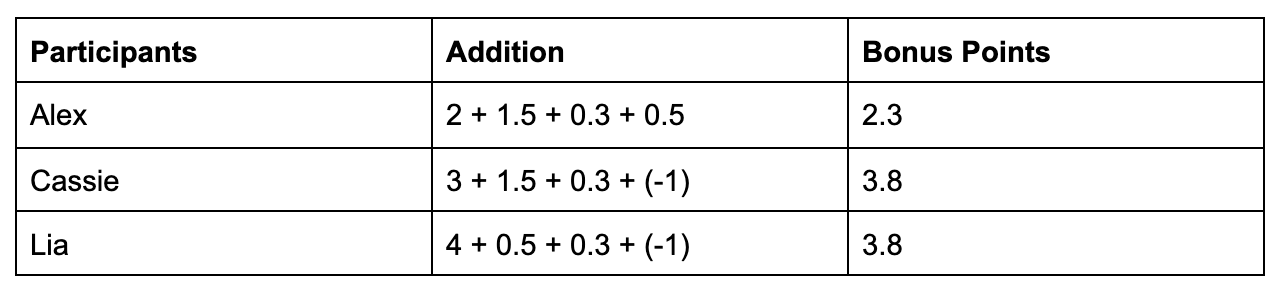
The total payoff matches the teacher’s awarded 10 points, and the allocation reflects both individual efforts and team dynamics.
We can formalize our system like so:
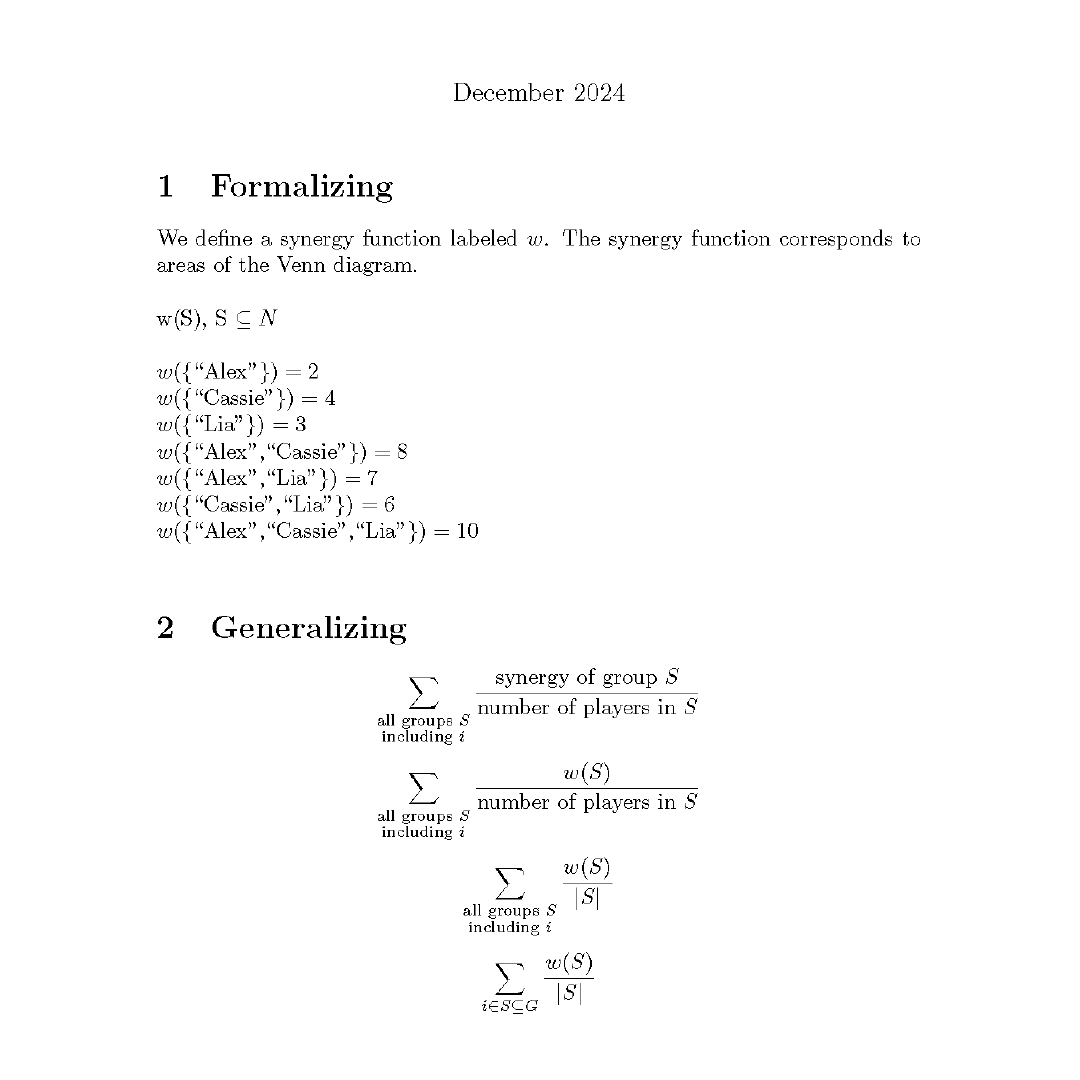
In conclusion, the Shapely Value Grading Framework ensures:
Efficiency: All points are allocated without surplus or deficit.
Symmetry: Identical contributions yield equal rewards.
Fairness: Those who contribute nothing receive nothing.
---